
Factory drop testing
Carton Drop Height and Gross Weight for Jewelry Cabinets
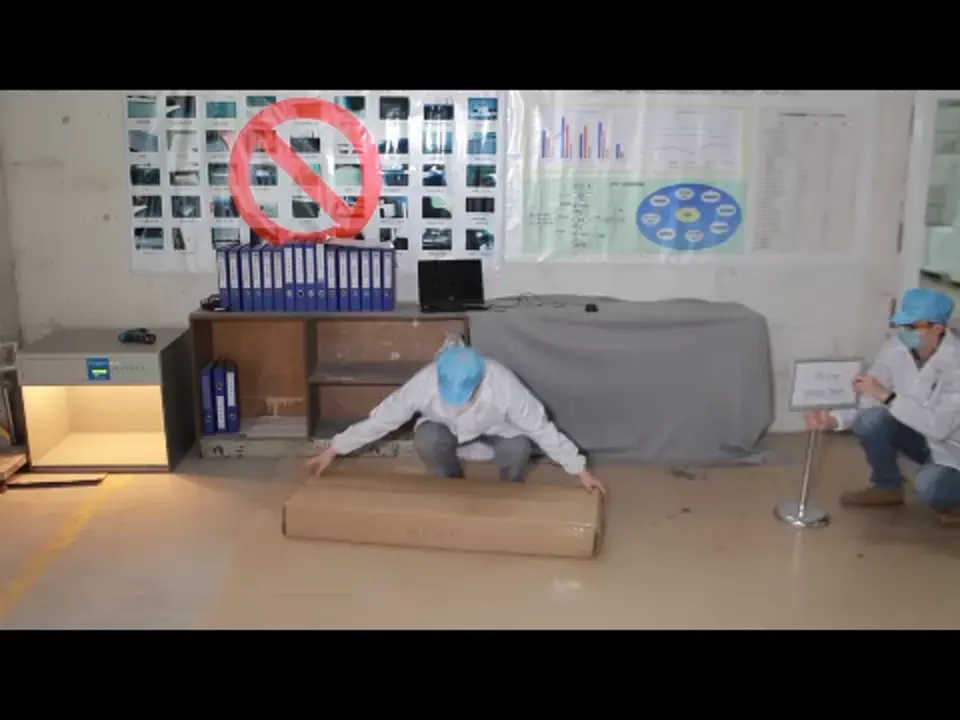
Use the weight of the complete shipping carton when a procedure assigns a height by weight. Include the mirror, cabinet, stand or accessories in that carton, inserts and outer box. Do not substitute the cabinet’s net weight. If the freestanding support or wall hardware travels in another carton, ask which package the weight table applies to. For borderline cases, send the lab the measured gross weight, units and tolerance and ask for the applicable band in the current procedure.
Read the height in the context of its own test
In protocols that use weight bands, heavier cartons may be assigned lower free-fall heights. Other tests specify different heights within one sequence. For example, the two supplied W6703BM and W6813S lab reports record steps at 18 and 36 inches, plus a separate rotational edge event for one sample. The two cartons differ in mass, yet the logged numbered drop heights are the same. This is an example of how procedure and orientation matter as much as gross weight.
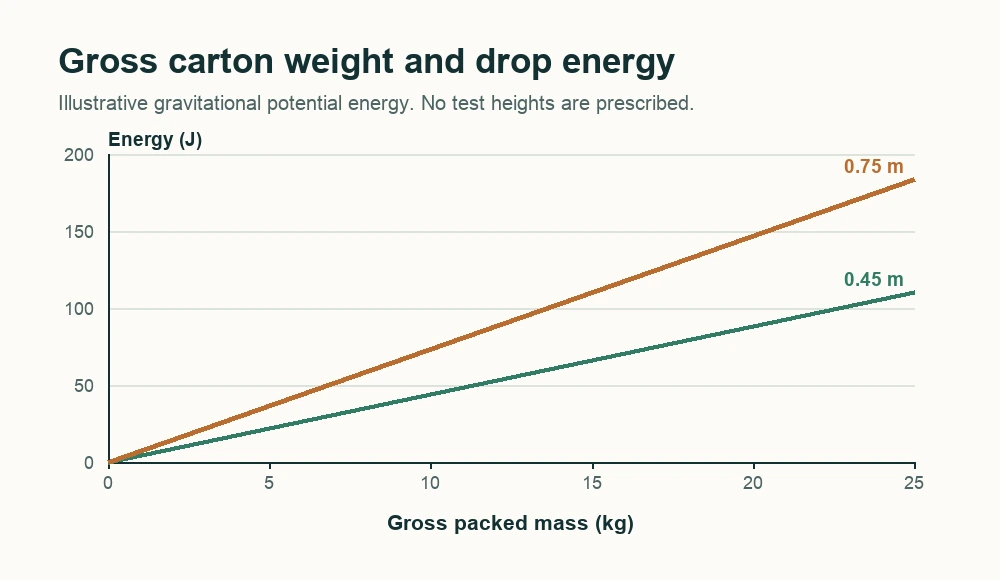
| Gross packed mass | 0.45 m, approximate energy | 0.75 m, approximate energy |
|---|---|---|
| 5 kg | 22 J | 37 J |
| 10 kg | 44 J | 74 J |
| 15 kg | 66 J | 110 J |
| 25 kg | 110 J | 184 J |
The numbers use standard approximate gravity of 9.81 m/s² and show ideal gravitational potential energy before impact. A carton of twice the mass has roughly twice that energy at the same height. An impact does not transmit all this energy directly into the mirror. The insert, carton deformation, contact angle and glass support change the response. Treat the table as a comparison of conditions, never as a pass threshold.
Three checks on the lab request
- Confirm whether the method is fixed height, weight dependent, or orientation dependent.
- Record the actual heights and units for each event. For comparison, 18 in equals 457.2 mm and 36 in equals 914.4 mm. Use the units the selected method defines for the test.
- If gross weight changes after a stand, carton or insert revision, ask the lab to recheck the classification and heights before repeating the old program.
The useful deliverable is a signed step matrix that includes package ID, measured packed weight, orientation and target height. With that matrix, two labs can explain why their programs match or differ.